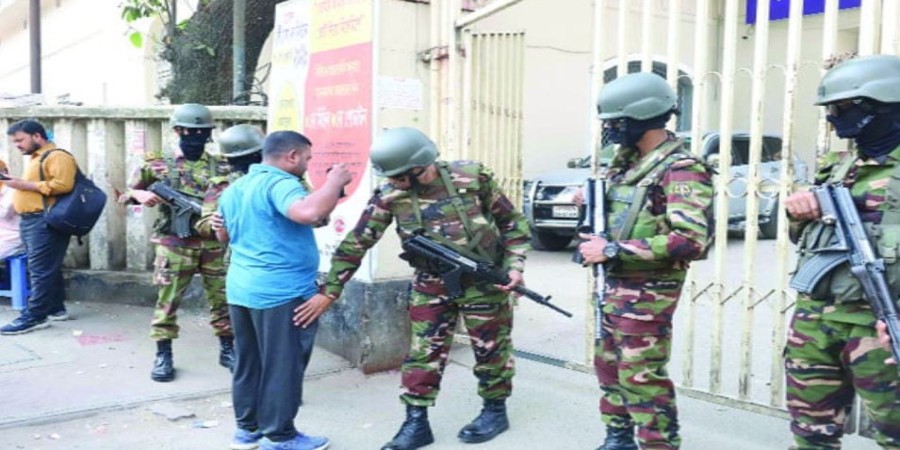
ছবি: ভোট সামনে রেখে রাজধানীতে গতকাল সেনাসদস্যদের তৎপরতা
Law enforcement agencies across the country have begun large-scale deployment to ensure the successful conduct of the 13th National Parliamentary Election and referendum, with members of all forces, including the armed forces, already on the ground and set to remain officially on duty for seven days alongside 1,051 executive magistrates. To guarantee a free, fair, and neutral election, members of the armed forces, Border Guard Bangladesh, Coast Guard, Rapid Action Battalion, police, APBN, and Ansar battalions are working as mobile and striking forces, with BGB, RAB, APBN, and Ansar units operating at district, upazila, and police station levels, while the Coast Guard has been deployed in coastal areas. Officials said more than 970,000 members of various law enforcement agencies are engaged in election duties, including 576,483 members of Ansar and Village Defence Party, 103,000 from the army, 5,000 from the navy, 3,730 from the air force, 37,453 from BGB, 3,585 from the Coast Guard, 187,603 police personnel, and 9,349 members of RAB, in addition to 45,820 village police. Authorities said all forces will work in coordination to respond immediately to any reports of violence or untoward incidents during the voting period. From securing polling stations to operating as mobile and striking forces, all units will function under the authority of returning officers, while members of the armed forces have been deployed to assist the civil administration. Preparations have been completed to ensure security at all 42,779 polling centers across the country. To maintain peace, order, and neutrality in the election process, police, BGB, Ansar-VDP, and Coast Guard units have been deployed, while armed forces personnel are assisting under the “in aid to civil power” framework. A total of 1,051 executive magistrates have been deployed since yesterday and will remain on duty until February 14, according to election officials. At the same time, the formal election duties of additional army personnel and other law enforcement members have also begun. The Election Commission stated that the law and order situation is normal and conducive to the election, with all ballot boxes already dispatched to districts and received by returning officers. According to a circular from the Home Ministry, outside metropolitan areas, 16–17 police and Ansar members have been deployed at general polling stations and 17–18 at high-risk stations, while in metropolitan areas 16 members have been assigned to general stations and 17 to high-risk ones. In designated difficult areas across 25 districts, 16–18 members have been deployed at each center, starting from two days before the vote. Citizens have been advised to report election-related complaints to the law enforcement coordination cell by calling 999. Police authorities said 187,603 police personnel are on election duty, including 157,000 assigned directly to polling station security, with the rest serving in supporting roles. The police chief instructed all members to maintain neutrality, professionalism, and adherence to the law during the election period. Nearly 560,000 Ansar and VDP members have been on duty at 42,779 polling centers since February 7 and will continue until February 14. A total of 1,191 striking force teams have been formed at the upazila level, each consisting of 10 members, and two Ansar or VDP personnel at each polling station are connected through a security app to report any incidents instantly. The Coast Guard said 3,585 of its members have been deployed since January 18 at coastal and riverine polling stations in remote and important areas and will remain until February 14, with special intelligence monitoring, drone surveillance, regular patrols, and legal measures in place to address any risks. BGB officials said more than 37,000 members have been deployed nationwide while ensuring full security along the country’s 4,427-kilometer border, with BGB operating in 489 out of 495 upazilas and taking sole responsibility in 61 border upazilas. Based on risk assessment, BGB units are serving as mobile and static forces in all 299 parliamentary constituencies, with two to four platoons assigned per upazila, and rapid action teams, dog squads, helicopters, and quick response forces kept ready for emergencies. In the 13th National Parliamentary Election, a total of 2,009 candidates are contesting in 299 constituencies, including more than 250 independent candidates and nominees from 51 political parties.
reporter