ছবি: Photo: Collected
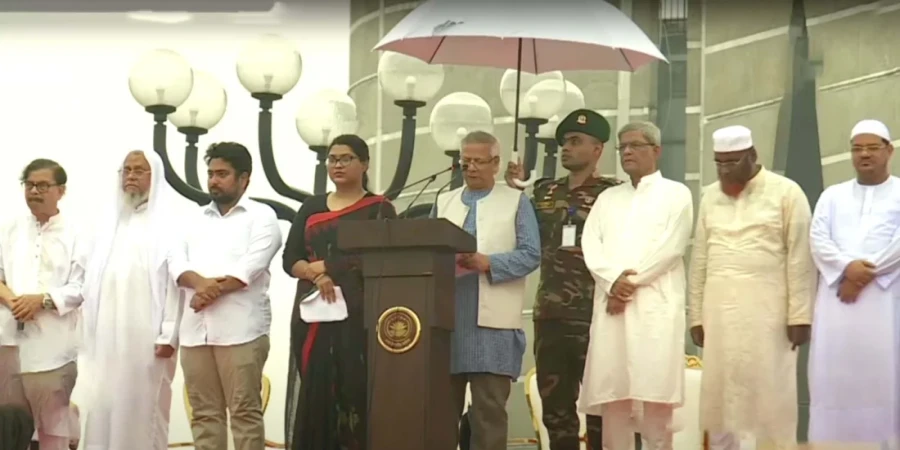
On Tuesday, marking one year since the collapse of the Hasina regime, Interim Chief Advisor Dr. Muhammad Yunus unveiled the historic 28-point July Declaration at a public rally held on Manik Mia Avenue in the capital. The declaration, presented as the collective will of the people, outlines the background, justification, and future aspirations of a post-authoritarian Bangladesh, placing special emphasis on granting full constitutional recognition to the 2024 student-led uprising.
The event was attended by several prominent political leaders, including BNP Secretary General Mirza Fakhrul Islam Alamgir, Jamaat-e-Islami’s Secretary General Professor Mia Golam Parwar, and NCP Convener Md. Nahid Islam. Together, they stood beside the chief advisor as the nation reflected on a transformative year shaped by political rebellion and social awakening.
The declaration retraces Bangladesh’s historical trajectory from its anti-colonial roots to the Liberation War of 1971. It asserts that the hopes embedded in the declaration of independence—equality, human dignity, and social justice—remained largely unfulfilled in the post-independence years. It criticizes the initial failures of the 1972 Constitution and the imposition of one-party rule under BAKSAL, which, it states, eroded democratic institutions and triggered mass discontent.
The declaration identifies subsequent turning points in the nation's history, including the popular uprisings of 1975 and 1990, which it views as critical corrections against authoritarianism. However, it claims that these gains were once again reversed by political conspiracies that paved the way for Sheikh Hasina’s authoritarian consolidation, particularly following the political crisis of 1/11.
The document heavily criticizes the 16-year rule of Hasina’s government, describing it as fascist, corrupt, and repressive. It accuses the administration of subverting the constitution, suppressing dissent, undermining judicial independence, and orchestrating enforced disappearances and extrajudicial killings. The document claims that all major state institutions were co-opted or destroyed to entrench one-party dominance.
The declaration links widespread corruption, economic collapse, environmental degradation, and international disgrace to what it calls the Hasina regime’s false promises of development. It emphasizes that repeated electoral manipulations in 2014, 2018, and 2024 stripped the people of their voting rights and rendered the government illegitimate.
It recounts the mounting public resistance—particularly by students, job-seekers, and opposition activists—against state violence, systemic discrimination, and government job quotas. The death of protesters and brutal crackdowns, it claims, ignited a spontaneous and sweeping student-led uprising in July 2024 that drew in broad sections of society, from workers to professionals, and even members of the armed forces.
The document declares that the uprising culminated in a nationwide long march to Dhaka on August 5, 2024, which ultimately forced Sheikh Hasina to resign and flee the country. Following this, the declaration notes that the 12th National Parliament was dissolved, and an interim government was formed under the leadership of Dr. Yunus, in accordance with Article 106 of the Constitution and with the guidance of the Supreme Court.
The declaration affirms the popular demand for a new political arrangement that ensures the rule of law, a fair electoral process, and an accountable, inclusive democratic state. It pledges institutional reform, environmental sustainability, and the protection of future generations through a development model rooted in justice and equity.
Central to the declaration is the formal recognition of the 2024 student uprising as a pivotal event in national history. It promises that the uprising will be granted full state and constitutional recognition and that its legacy will be permanently enshrined in the annex of the reformed constitution to be adopted by the next elected government.
The document also outlines the people’s intent to hold the former regime accountable for crimes against humanity, enforced disappearances, corruption, and state-sponsored violence. It honors the martyrs of the July uprising as national heroes and commits to providing legal and social protections for their families and for injured protesters.
The 28-point July Declaration stands as a manifesto of the people’s will—a blueprint for a future shaped not by repression and fear, but by justice, participation, and democratic renewal. As Bangladesh looks ahead, the declaration closes with a call for unity in building a society free from fascism, corruption, inequality, and authoritarianism—ensuring that the sacrifices of 2024 are not forgotten, but institutionalized in the very fabric of the state.
reporter