ছবি: ফাইল ছবি
The results of the country’s thirteenth national parliamentary election have now been largely announced, clarifying the composition of the new 300-seat legislature and signaling a major shift in the political landscape. With results declared for most constituencies, the election has produced a clear mandate and reshaped power dynamics across the country.
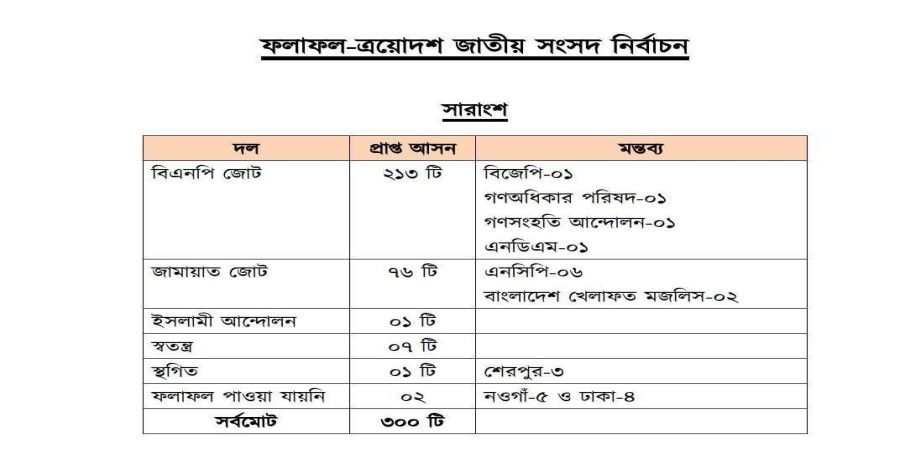
According to the published outcomes, the alliance led by the Bangladesh Nationalist Party (BNP) emerged as the dominant force in parliament. The BNP-led alliance secured a total of 213 seats, comfortably surpassing the threshold needed to form a government. Within this bloc, the BNP alone won 201 seats, marking one of the strongest performances in the party’s history. Its allies—the Gano Odhikar Parishad, Ganosanghati Andolon, and the National Democratic Movement—each captured one seat, reinforcing the coalition’s commanding position.
The Jamaat alliance also posted a significant showing, winning a total of 76 seats. This outcome positions the alliance as a substantial bloc in the new parliament, capable of influencing legislative debates and political negotiations. Among its partners, the National Citizen Party secured six seats, while the Bangladesh Khilafat Majlis won two. In addition, Islami Andolon Bangladesh captured one seat, adding to the diversity of representation.
Independent candidates also made their mark, winning seven seats across the country. Analysts view this as a sign that a segment of the electorate continues to value individual candidates beyond party affiliations, potentially enriching parliamentary discourse with independent perspectives.
Not all constituencies have finalized outcomes. Voting in Sherpur-3 has been suspended, while results for Naogaon-5 and Dhaka-4 are still pending. Although these unresolved seats may slightly adjust final tallies, they are not expected to alter the overall balance of power in the new parliament.
The election results point to a decisive mandate and the beginning of a new political chapter. High voter turnout, a largely orderly voting process, and broadly accepted results have raised public expectations for stability and reform. With a strong majority, the BNP-led alliance now faces the responsibility of governing effectively, strengthening democratic institutions, and addressing pressing economic and social challenges.
At the same time, the presence of sizable opposition and smaller parties underscores the importance of constructive parliamentary engagement. Taken together, the outcomes of the thirteenth national parliamentary election mark a turning point in Bangladesh’s political trajectory, setting the stage for a redefined balance between power, opposition, and public accountability.
reporter