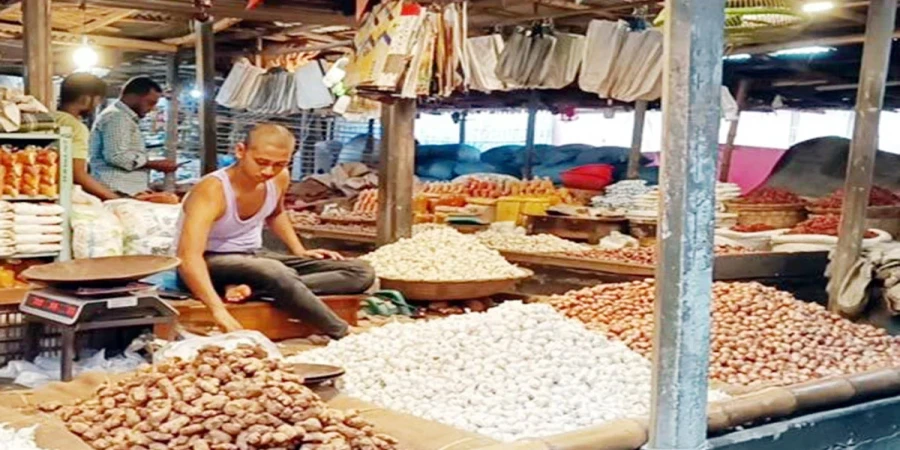
ছবি: Photo: Collected
In Hili, a notable price hike in essential kitchen staples such as potatoes, onions, ginger, and eggs is putting financial pressure on low-income families. Over the span of just two days, the prices of these everyday items have surged significantly, increasing by Tk 4 to Tk 60 depending on the product. At the same time, the retail market has seen a welcome drop in cumin prices, attributed to an increase in imports from India through the Hili land port.
A visit to the Hili market on Monday revealed the sudden price changes. Onions that were selling for Tk 50 per kilogram just two days ago are now priced at Tk 70. Ginger, previously available at Tk 100 per kilogram, is now being sold at Tk 160. Potato prices have climbed from Tk 14 to Tk 18 per kilogram, and eggs have seen a sharp rise as well—30 eggs are now selling for Tk 320, compared to Tk 280 just a few days earlier.
The price hike has hit low- and fixed-income groups especially hard. Consumers are expressing concern and frustration as their earnings remain stagnant while the cost of living continues to rise. Rafique, a buyer at the market, expressed his dismay, saying, “I bought onions for Tk 50 a kilo just the other day, and now it’s Tk 70. Our income doesn’t increase, but prices do. I urge the government to control this situation.”
Azad, another customer purchasing eggs, said the rising price of eggs is particularly painful for low-income families. “Eggs are often our only affordable source of protein since we can’t buy fish or meat regularly. If the price of eggs goes up, we suffer even more,” he explained.
Ali Hasan, who came to the market to buy potatoes and ginger, echoed similar frustrations. “Two days ago, I paid Tk 14 per kg for potatoes and Tk 90 for ginger. Today, I had to pay Tk 18 and Tk 150 respectively. It’s frustrating. Everything seems more expensive each day.”
Retailers in the Hili market offered some explanations for the price spikes. Shakil Ahmed, a local vegetable vendor, said the primary issue lies in the supply chain. “There’s a supply shortage of local onions at the wholesale level. Previously, I was buying onions at Tk 48–50 per kilogram. Now, the price at the wholesale market has increased to Tk 60–62 per kg. That’s why we are forced to sell at higher prices in retail,” he said.
In contrast, cumin—a key kitchen spice—has seen a welcome drop in price. Over the past three weeks, cumin prices have declined by Tk 70 per kilogram. Where it was selling at Tk 600 per kg earlier, it is now priced at Tk 530 per kg. Compared to the same period last year, when cumin was priced between Tk 1,000 and Tk 1,100, the current rate represents a significant decline.
This price reduction has been met with satisfaction from both buyers and sellers. Retailer Awlad Hossain Shawon explained, “A large quantity of cumin has been imported through the Hili land port, and import levels are currently stable. On top of that, consumer demand has been low for spices in recent weeks, which has helped reduce the price.”
Customers like Mahbub, who came to the market to purchase spices, welcomed the change. “Just two months ago, I paid over Tk 600 for a kilogram of cumin. Today, I bought it for Tk 530. Since the price is lower now, I decided to buy a full kilogram,” he said.
Although the drop in cumin prices has offered some relief to households, it has done little to offset the stress caused by the rising cost of essential vegetables and protein items. Many in the community are urging authorities to intervene and stabilize market prices before the situation worsens for ordinary families.
As food prices remain volatile and unpredictable, the people of Hili are caught between relief and concern—grateful for the lower cost of some goods, yet worried about the spiraling prices of others. For now, they continue to navigate the shifting dynamics of the market, hoping for better days ahead.
reporter