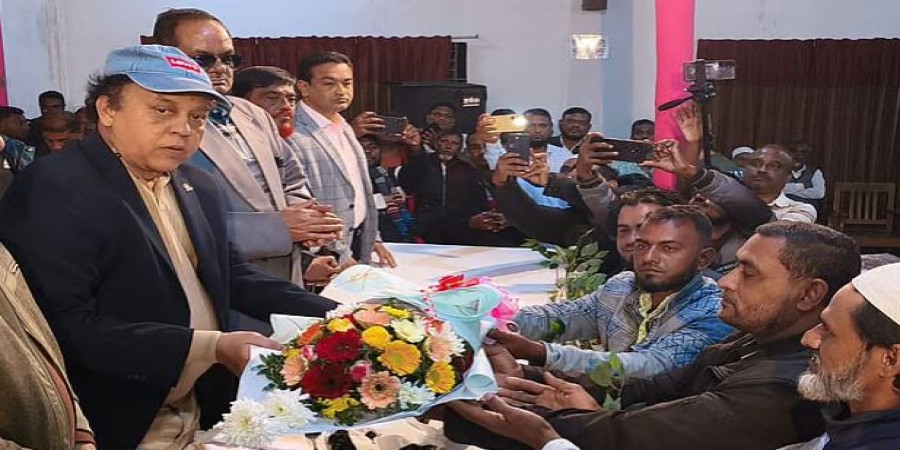
ছবি: খাগড়াছড়ি আসনের বিএনপির মনোনীত প্রার্থী ও জেলা বিএনপির সভাপতি ওয়াদুদ ভুইয়াকে ফুলের তোড়া তুলে দিচ্ছেন দলে নবাগতদের কয়েকজন। গতকাল সন্ধ্যায় উপজেলার একটি কমিউটিনিটি সেন্টারে
In Khagrachhari’s Matiranga upazila, a notable political shift took place as more than five hundred grassroots-level leaders and activists of the Awami League, Jatiya Party, and National Citizens Party (NCP) joined the Bangladesh Nationalist Party (BNP), reshaping local electoral dynamics ahead of the upcoming national elections. The joining ceremony was held at a local community center on Monday evening where the new members formally greeted BNP’s district President and nominated candidate Wadud Bhuiyan with floral bouquets, symbolizing their political transition and allegiance. Among the individuals who switched sides were Matiranga Municipality’s expelled Awami League General Secretary Saiful Islam, Municipal Jatiya Party General Secretary Alauddin, NCP leader Liton Biswas, and a large number of ward-level activists who had been involved in grassroots coordination and campaign mobilization for their former parties over the years. In their remarks, many expressed dissatisfaction with what they described as prolonged political stagnation, lack of participation opportunities, limited democratic space, and the absence of an inclusive electoral environment, which they argue have collectively contributed to declining voter trust. Several of them stated that BNP’s increased activism on the streets and its messaging around voting rights and democratic restoration influenced their decision, as they now consider the BNP to be a more viable platform for competitive politics.
BNP candidate Wadud Bhuiyan, while welcoming the new members, stated that the party’s organizational strength in the hill district has been expanding from the union level upward, and that the inclusion of diverse political backgrounds will strengthen campaign strategy and voter outreach. Political analysts note that Khagrachhari is a historically sensitive region where ethnic, local, and national political strands intersect, particularly involving interactions between Bengali settlers, indigenous communities, various regional groups, and mainstream national parties. In recent decades, the district has witnessed electoral volatility shaped by issues such as land disputes, identity politics, peace accord debates, and competing development narratives. Observers suggest that a mass shift of supporters—especially from parties with previously established local presence—may influence campaign dynamics in several union areas where political contests are typically tight. However, several Jatiya Party and NCP leaders downplayed the broader impact of the defection, arguing that many of those who switched had been inactive or detached from party activities, and therefore their departure may not significantly alter party performance or voter influence. They stressed that electoral outcomes in hill districts depend not only on numerical strength but also on alliance strategy, organizational cohesion, voter sentiment, and candidate reputation.
Political analysts also point out that the timing of the shift highlights intensifying pre-election maneuvering in the national political landscape, where BNP has been openly working to rebuild its grassroots networks after years of organizational challenges, arrests, restrictions, and leadership disruptions. Over the past several months, BNP has increased public gatherings, courtyard meetings, and direct voter engagement initiatives across hill districts, signaling a renewed strategy tailored toward mobilizing both disaffected voters and silent segments who previously opted out of political participation. Local residents have also expressed curiosity about whether such realignments indicate a potential rebalancing of political influence or merely reflect short-term tactical repositioning ahead of the election cycle. Analysts argue that political migration traditionally plays a symbolic role in Bangladesh’s electoral politics, as it sends signals to undecided voters regarding momentum, organizational confidence, and perceived prospects of electoral competitiveness. In the case of Matiranga, while it is too early to assess the exact electoral impact, the event has introduced new debates over party strength and coalition-building in Khagrachhari, a district long viewed as a testing ground for how national politics interacts with complex local realities.
reporter