ছবি: Photo: Collected
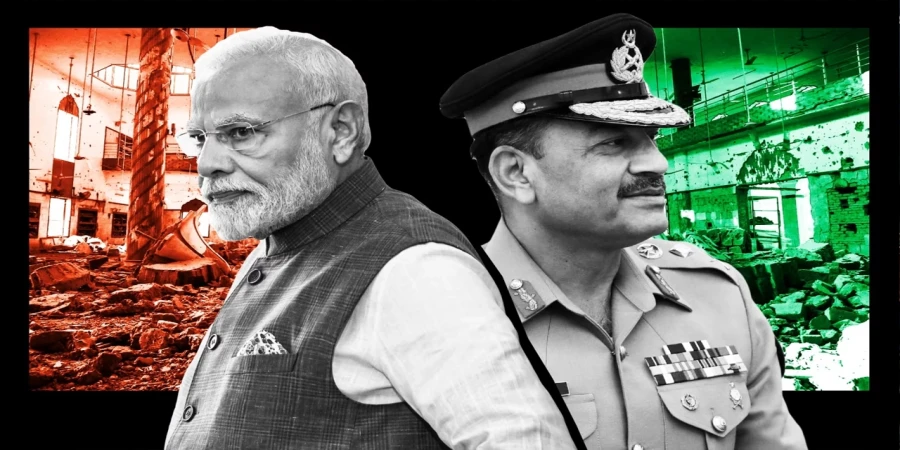
A recent conflict between India and Pakistan escalated into a dramatic and multifaceted clash, with both nations suffering significant military, strategic, and humanitarian losses. The short yet intense 87-hour war began when India launched an attack on Pakistan at 1:05 AM on May 7, codenamed ‘Operation Sindhur’. The Indian government claimed that the operation was retaliation for a terrorist attack in Pahalgam, located in Indian-controlled Kashmir.
During the operation, India deployed advanced Rafale fighter jets, which launched Storm Shadow missiles and Hammer bombs. The primary objective of the mission was to target nine ‘military-supported civilian’ infrastructures in Pakistan, which included suspected bases, communication centers, and supply chains.
Alongside the aerial assault, India also carried out drone strikes and surveillance operations to test Pakistan’s air defense capabilities. In response, Pakistan swiftly mounted a defense, deploying J-10C fighter jets and utilizing Coral Electronic Jamming Systems to disrupt India's aircraft and drones. Pakistan claimed to have shot down three Rafale jets and destroyed twelve Indian drones with the help of electronic warfare and missile defense systems.
Despite the short duration of the conflict, the economic impact was severe. According to reports, the conflict resulted in a staggering economic blow, with India suffering losses that amounted to approximately $83 billion, which is 20 times higher than Pakistan’s total damage.
The financial toll on India was immense. Due to the closure of North India’s airspace, India incurred daily losses of $8 million in aviation. The suspension of the Indian Premier League (IPL) resulted in a loss of $50 million. Military expenses added another $100 million, and the loss of fighter jets contributed to $400 million in damages. Furthermore, the logistical and trade sectors also faced significant setbacks, with losses exceeding $2 billion.
On the other hand, Pakistan’s estimated losses amounted to around $4 billion. Karachi’s stock market index plummeted, leading to a loss of $2.5 billion. The suspension of the Pakistan Super League (PSL) resulted in a further $10 million in losses. The closure of Pakistan’s airspace contributed to a loss of $20 million, while daily military expenses added another $25 million. Additionally, Pakistan’s missile and drone costs were approximately $300 million.
The conflict demonstrated the new reality of modern warfare, where economic stability plays a crucial role alongside traditional military assets such as tanks, fighter jets, and artillery. In this modern age, the cost of war is not limited to the battlefield—it extends to the economy, affecting investments, stock markets, and creating widespread insecurity. The fact that over $1 billion in damages occurred every hour of the conflict underscores how costly modern warfare can be for a nation’s economy and the global financial system.
Analysts argue that the real success of a modern war is not only determined by military strength but also by a country’s economic capacity, technological control, and influence over public perception. As a result, countries now view strategies such as cyber and economic resilience, diplomatic effectiveness, and the ability to prevent conflicts as key aspects of national power.
This brief yet devastating conflict between India and Pakistan offers a grim warning for the future: Even short, limited clashes can lead to disproportionate economic, diplomatic, and social repercussions. In the face of modern warfare, prevention, peace, and mutual understanding are increasingly seen as the only viable paths to regional stability.
reporter