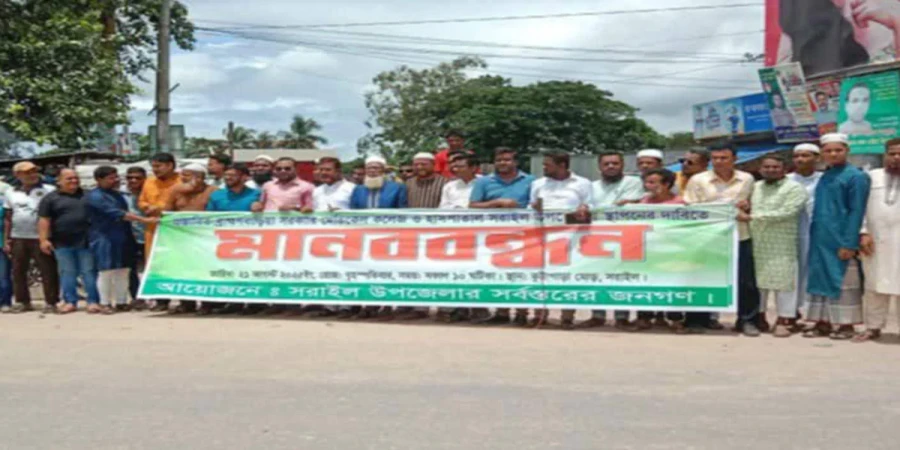
ছবি: -Collected Photo
A human chain was organized on Thursday, August 21, demanding the establishment of the proposed Brahmanbaria Government Medical College and Hospital in Sarail upazila. The demonstration, held at Kuttapara on the Dhaka-Sylhet Highway at 11 a.m., was arranged under the banner of “People of All Walks of Life of the Upazila.” Participants included leaders and activists of the Bangladesh Nationalist Party (BNP) and its affiliated bodies, businessmen, social and professional organizations, as well as local residents.
The event was presided over by Anisul Islam Thakur, president of Sarail Upazila BNP, while Mashiur Rahman Master, convener of the Krishak Dal, conducted the program. Among the speakers were organizational secretary Dulal Mahmud, Jubo Dal convener Abu Sufian, Sadar Union Parishad chairman Abdul Jabbar, BNP office secretary Salauddin Ahmed Biplob, cultural wing leader Ripon Thakur, Swechchhasebak Dal convener Mehedi Hasan Palash, and Maulana Habibur Rahman.
Speakers at the demonstration highlighted the long-standing neglect of Sarail in the field of healthcare. Despite the presence of numerous private hospitals in Brahmanbaria district, they pointed out that residents of Sarail continue to face significant challenges in accessing proper medical treatment. Many patients are compelled to travel long distances for specialized care, often enduring considerable hardship.
The speakers emphasized that Sarail holds strategic importance as it lies at a critical junction of national highways. Located at the crossroads of the Dhaka-Sylhet and Cumilla-Chattogram-Sylhet highways, the upazila is well-connected to major cities including Dhaka and Sylhet, as well as neighboring districts. They argued that establishing a government medical college and hospital in this location would not only benefit the residents of Sarail but also provide accessible healthcare facilities to people from adjoining regions.
The demand for the medical college has been longstanding, with locals expressing frustration over the slow progress of healthcare development in the area. According to the demonstrators, while urban centers within Brahmanbaria have seen the growth of private healthcare institutions, Sarail has been left without adequate public medical infrastructure. They noted that World Road and Kuttapara are areas of national significance, yet they lack essential facilities such as a government hospital.
The participants of the human chain argued that the proposed medical college and hospital would serve a much broader population, easing pressure on healthcare facilities in Dhaka and Sylhet. They asserted that patients from nearby districts could receive treatment in Sarail without traveling long distances, which would save both time and resources. Furthermore, the presence of a medical college would foster educational opportunities, creating a new hub for medical training and professional development in the region.
The demonstration concluded with the submission of a memorandum to the Sarail Upazila Nirbahi Officer (UNO), outlining the collective demand of the people. Local leaders expressed hope that the government would take the appeal seriously, considering the strategic location and pressing healthcare needs of the population.
Speakers at the event also drew attention to the socioeconomic impact of a medical college in Sarail. They argued that besides improving healthcare services, such an institution would generate employment, enhance business opportunities, and stimulate overall development in the area. The initiative, they said, would transform Sarail into a regional center for healthcare and education, benefiting communities beyond Brahmanbaria.
They warned that continued neglect of Sarail’s healthcare demands would deepen public dissatisfaction. By investing in public medical infrastructure in this location, the government could not only address health needs but also strengthen public trust in its commitment to equitable development across regions.
Thursday’s human chain served as a display of unity, with political figures, professionals, and ordinary citizens standing together for a common cause. Organizers noted that the demand transcends partisan politics and reflects the collective aspiration of Sarail’s residents for improved healthcare access.
The call for establishing the Brahmanbaria Government Medical College in Sarail adds to the broader national discourse on healthcare equity, especially in rural and semi-urban areas. While Bangladesh has made notable progress in expanding healthcare facilities, disparities remain between urban centers and less-developed upazilas. Demonstrators in Sarail insist that the government’s recognition of their demand would mark a significant step toward reducing this gap.
As the memorandum now rests with the local administration, residents of Sarail await further action, hopeful that their demand will reach the relevant authorities in Dhaka. They expressed optimism that with sustained pressure and collective advocacy, the proposed medical college and hospital in Sarail will become a reality, ensuring better healthcare for present and future generations.
reporter