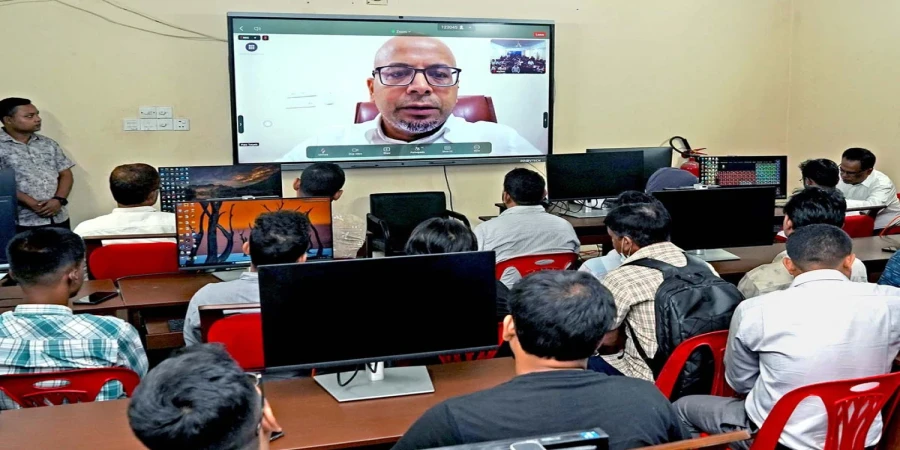
ছবি: -Collected Photo
The Government of Bangladesh has announced an ambitious plan to provide digital skills training to 100,000 students across the country, with a special focus on equipping them with knowledge of artificial intelligence and emerging technologies. Fayez Ahmed Tayyeb, Special Assistant to the Chief Adviser on Posts, Telecommunications and Information Technology, made the announcement while virtually inaugurating a training program in Rangpur.
Speaking at the launch of a seven-day training program for July fighters on computer fundamentals and digital marketing at the Bangladesh Computer Council’s (BCC) regional office in Rangpur on Wednesday, Tayyeb underlined the urgency of preparing the country’s youth for the rapidly evolving digital economy. He stressed that without knowledge of artificial intelligence and generative AI, the nation risks falling behind both domestically and internationally.
According to him, the training initiative will be shaped with input from participants to ensure its relevance in today’s fast-changing technological landscape. The government aims to turn this initiative into a foundation for Bangladesh’s digital transformation, with a particular focus on involving students, youth, and marginalized groups.
Tayyeb noted that Rangpur had been chosen as the starting point for this nationwide training program in recognition of the sacrifices of its people and to address the historical socio-political disadvantages the region has faced. “We remember with deep respect the sacrifices of the people of Rangpur. That is why we are beginning this training here. Rangpur has long been held back due to past political cultures, but through ICT we want to move this region forward. We are also working with Begum Rokeya University to explore collaborative opportunities,” he said.
The Special Assistant outlined that the training program is designed in phases. In the initial stage, students in schools and colleges will undergo a 42-hour introductory ICT training. Based on the outcomes of this first step, participants will be offered more advanced training in subsequent phases. Plans are also in place to include madrasa students in the program to ensure inclusivity.
Highlighting the broader scope of the initiative, Tayyeb announced that ten Research and Innovation Centers (RIC Labs) would be established in ten public universities. These labs will allow students to engage in hands-on research and innovation. Additionally, the government is planning mobile ICT labs equipped in vehicles, designed to bring training facilities directly to people’s locations. “Through these mobile labs, training will reach people wherever they are, ensuring no community is left behind,” he explained.
ICT Division Secretary Shish Haydar Chowdhury, who chaired the event, emphasized the symbolic timing of the training’s launch. “On the anniversary of the July uprising, we are beginning this program from the land of martyr Abu Sayeed. The aim is to integrate July fighters into our vision for digital transformation. This training is an important step in making them active participants in building a digital Bangladesh,” he said.
The initial training sessions in Rangpur have already started, with 20 participants being trained in computer fundamentals and another 20 in digital marketing. Organized by the Bangladesh Computer Council, the program for July fighters will gradually expand, with plans to roll out similar initiatives across the country in the coming months.
This new program builds on earlier training initiatives. For instance, a month-long program involving 160 students from Gorostan Jamia Islamia Darus-Sunnah Madrasa in Tangail concluded on August 16. Similar training sessions are already scheduled for madrasa students in Chattogram, Cumilla, and Tangail, covering a total of 740 students under the same umbrella program. These efforts underline the government’s commitment to extending digital literacy and skills beyond traditional academic institutions.
Tayyeb stressed that the government’s vision for digital skills training extends beyond mere technological literacy. Instead, it is about preparing young people to adapt to disruptive technologies such as AI and leveraging these tools for innovation, entrepreneurship, and global competitiveness. He urged students and trainees to embrace the opportunities provided through the program and highlighted that their feedback will be crucial in shaping the structure and content of training modules moving forward.
The government sees the introduction of AI knowledge and skills as a cornerstone of its strategy to transform Bangladesh into a digitally empowered nation. As global economies rapidly adopt generative AI and automation, Bangladesh is positioning itself to ensure its workforce is competitive and ready to seize international opportunities.
Beyond technical training, the government aims to create an ecosystem where innovation can flourish. The establishment of RIC labs and mobile ICT training units reflects a broader vision of decentralizing access to technology and bridging the urban-rural divide. This initiative not only empowers students but also aims to strengthen regional economies by enabling young people to apply digital skills in their communities.
Stakeholders believe that such programs will not only benefit students but also contribute to the overall growth of the nation’s ICT sector. With the increasing demand for skilled professionals in fields such as digital marketing, programming, and AI development, the initiative has the potential to create a new generation of digitally skilled youth capable of driving Bangladesh’s development agenda forward.
As the first batches of students undergo training, expectations are high that the program will inspire confidence among participants and provide them with practical skills to thrive in a digital economy. The government remains optimistic that this large-scale digital training project will set a benchmark for future educational initiatives, ensuring that the nation’s youth are not left behind in the global race toward technological advancement.
reporter