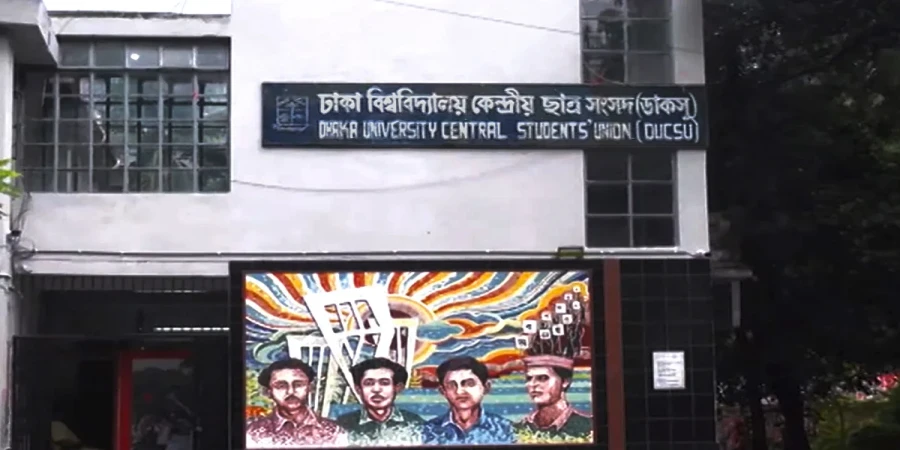
ছবি: -Collected Photo
The long-anticipated Dhaka University Central Students’ Union (DUCSU) election, which had faced a sudden setback earlier this week, is now set to move forward as scheduled. The Chamber Judge Court has stayed a High Court order that had temporarily halted the polls until October 30, removing legal obstacles and allowing the university administration to continue with preparations for one of the most significant student political events in the country.
The controversy began on Monday when a High Court bench comprising Justice Habibul Gani and Justice SK Tohin Ali issued an order suspending the DUCSU election until October 30. That order raised concerns about a possible prolonged delay in a process that already carries immense political and historical importance within the academic community of Dhaka University. The sudden intervention of the High Court came as a surprise to many, as political groups across the spectrum had already begun mobilizing ahead of the scheduled vote.
The suspension order, however, did not last long. Following an urgent appeal from the university authorities, the matter was taken up in the Chamber Judge Court. On Tuesday, the Chamber Judge responded in favor of the petition, issuing an order that effectively stayed the High Court’s decision. This reversal means the DUCSU election will now proceed without disruption, a development that was immediately welcomed by student organizations that had been preparing for active participation in the polls.
Dhaka University’s lawyer, Advocate Shishir Monir, confirmed the outcome, stating that the Chamber Court’s intervention had restored the election process to its original track. According to him, the university administration had acted swiftly after the High Court’s ruling, seeking legal redress to prevent further delays. Their petition argued that the suspension was not only unnecessary but also harmful to the democratic practice and the rights of students to representation.
The DUCSU election holds a unique place in Bangladesh’s political culture. Once considered the cradle of national leadership, the student union elections at Dhaka University have historically shaped the political landscape of the country. Many of Bangladesh’s prominent political leaders, including those who played pivotal roles in the independence movement and in the post-independence era, began their journeys through DUCSU. The revival of the election after long intervals is therefore viewed as more than just a campus affair—it is seen as a microcosm of national politics, often influencing the wider political discourse.
The High Court’s earlier suspension order had been linked to procedural concerns raised by petitioners, who questioned aspects of the electoral process. While the details of those concerns were not immediately made public, it was understood that they related to student eligibility, voter lists, and the organizational framework of the polls. The Chamber Court, however, prioritized the importance of continuity in democratic exercises on campus, granting the university administration the authority to continue with its schedule while the larger legal issues remain under review.
For student organizations, the Chamber Court’s decision provides much-needed clarity. With less than two months to go before the polls, campaigns had already been gaining momentum. Political wings aligned with the country’s major parties—such as the Bangladesh Chhatra League and other groups—were actively preparing to field candidates, while independent student activists were also rallying for participation. The suspension had temporarily cast uncertainty over their activities, but with the latest ruling, momentum is expected to pick up again.
The Dhaka University administration, meanwhile, has assured students that it remains committed to conducting a free, fair, and participatory election. Officials noted that the university has been making extensive preparations to ensure that the vote takes place in a transparent manner, with adequate security and administrative measures. They also emphasized that the Chamber Court’s ruling allows them to proceed without fear of further disruptions, at least until the Supreme Court hears any additional appeals that may be filed.
Reactions across campus have been swift. Student leaders expressed relief at the decision, viewing it as a victory for student rights and democratic participation. Several groups issued statements highlighting that DUCSU is not merely a student body but an institution that embodies the democratic aspirations of young people. The suspension, they argued, would have weakened those aspirations, while the Chamber Court’s ruling has re-energized the election process.
Legal experts also weighed in, noting that the Chamber Court’s role was to ensure that an important institutional process did not stall unnecessarily. While the larger questions raised before the High Court will likely remain part of ongoing legal discourse, the immediate priority has been to safeguard the continuity of democratic activity at Dhaka University.
As it stands now, the DUCSU election is set to take place as scheduled, marking another chapter in the storied history of student politics in Bangladesh. For many observers, the developments highlight the delicate balance between judicial oversight and democratic necessity, and they underscore the enduring significance of DUCSU as a breeding ground for political leadership in the nation.
With the legal hurdle lifted, all eyes will now turn back to the campus, where campaigning, debates, and student engagement will intensify in the weeks leading up to the polls. The Chamber Court’s decision ensures that, at least for the moment, the democratic pulse of Dhaka University continues to beat strongly.
reporter