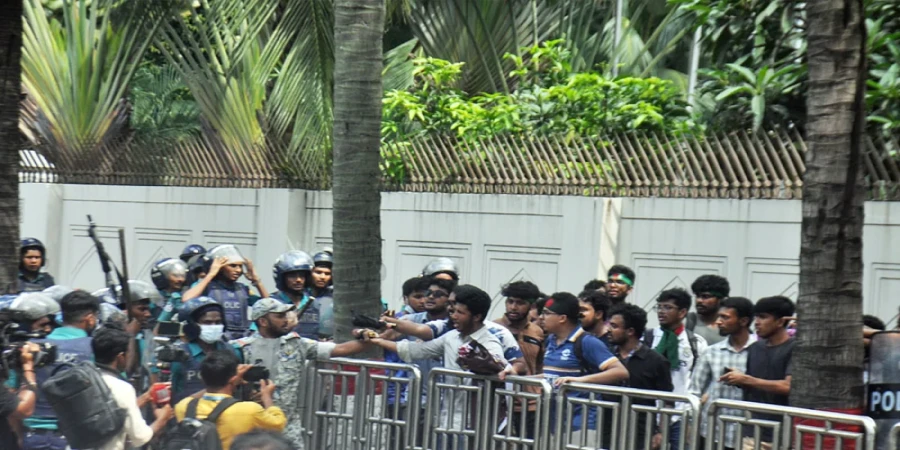
ছবি: -Collected Photo
Tensions flared in the heart of Dhaka on Wednesday afternoon as students of Bangladesh University of Engineering and Technology (BUET) clashed with police in front of the Intercontinental Hotel while demonstrating for their three-point demand. The protest, which began as a peaceful march towards the Chief Adviser’s official residence at Jamuna, turned confrontational when police blocked their advance, eventually deploying tear gas and sound grenades to disperse the crowd. Several students sustained injuries during the clash, prompting demonstrators to regroup at the Intercontinental intersection, where they staged a sit-in that left the area in a tense standoff.
The standoff began around 1:30 p.m. when the demonstrators attempted to march past police barricades at the Intercontinental intersection. Police officers, who had been stationed in anticipation of the protest, tried to prevent them from advancing further toward Jamuna. When students attempted to push through the barricades, law enforcement responded with volleys of tear shells and sound grenades, sparking chaos. For nearly an hour, the area was caught in a cycle of chase and counter-chase as students regrouped and chanted slogans while police sought to disperse them.
By 3:00 p.m., hundreds of students had taken position in front of the Intercontinental, vowing not to leave until their demands were addressed. The air was still thick with tear gas as injured students were assisted by their peers. Onlookers described the situation as “volatile,” with slogans echoing through the area demanding an end to what protesters termed “injustice in the name of quota.”
Among the slogans raised by students were chants of “No compromise, only struggle,” “Merit not quota,” “End the injustice of quota,” and “Return rights to the meritorious.” The chants reflected the central grievances of the movement, which has been gathering momentum over recent weeks.
The protesters, under the banner of Prokoushol Odhikar Andolon (Engineering Rights Movement), articulated three core demands. First, that diploma engineers not be allowed to prefix “engineer” before their names, as students argue it undermines the identity of graduates from universities of engineering. Second, they called for diploma engineers to be barred from receiving promotions into the ninth grade of government service. Finally, they demanded that entry-level positions in the tenth grade be reserved for graduates of engineering universities rather than diploma holders, claiming that the latter route diminishes opportunities for those who have undergone more rigorous academic training.
Speaking to reporters at the protest site, the movement’s General Secretary, Sakibul Islam Lipu, reiterated that students would not vacate their position until the authorities respond to their demands. “We have been repeatedly ignored. Today’s action shows the state is unwilling to listen to the rightful grievances of engineering students. We will not step back until justice is served,” he said.
The confrontation has reignited debate around the role and recognition of diploma engineers within Bangladesh’s professional and bureaucratic structures. Advocates for BUET students argue that academic and professional distinctions between diploma and university-trained engineers must be preserved to ensure fairness and maintain standards within the engineering sector. On the other hand, some policymakers and labor groups have expressed concern that excluding diploma holders could exacerbate inequality and unemployment.
The events on Wednesday, however, underscored how deeply the issue has polarized stakeholders. For the students, the conflict is about safeguarding professional recognition and meritocracy. For police, it was a matter of maintaining law and order in a high-security zone adjacent to the residences of top government officials.
As dusk approached, the Intercontinental intersection remained blocked by chanting students, surrounded by rows of riot police keeping close watch. Vehicular movement around the area was severely disrupted, with commuters forced to take alternative routes. Businesses in the vicinity reported closing early amid fears of escalation.
Although no fatalities were reported, the injuries suffered by several BUET students further fueled anger among protesters, many of whom accused the authorities of using disproportionate force. Civil society observers and human rights groups have already begun raising concerns about the heavy-handed response to what began as a student-led demonstration.
The protest reflects a wider undercurrent of student discontent that has often shaped the nation’s political landscape. With BUET students now pledging to continue their movement until their three demands are accepted, and the government showing no immediate signs of compromise, the capital could see further disruptions in the days ahead.
For now, Dhaka waits in uneasy anticipation as engineering students hold their ground at the Intercontinental, chanting for merit, recognition, and reform.
reporter