ছবি: -Collected Photo
Chief Advisor Professor Muhammad Yunus has declared that Bangladesh is now prepared to hold national elections in February 2026, describing the upcoming polls as a decisive moment in the country’s political history. He said the political environment had reached stability following last year’s violent unrest and the subsequent student-led uprising that toppled what he called a “fascist regime.”
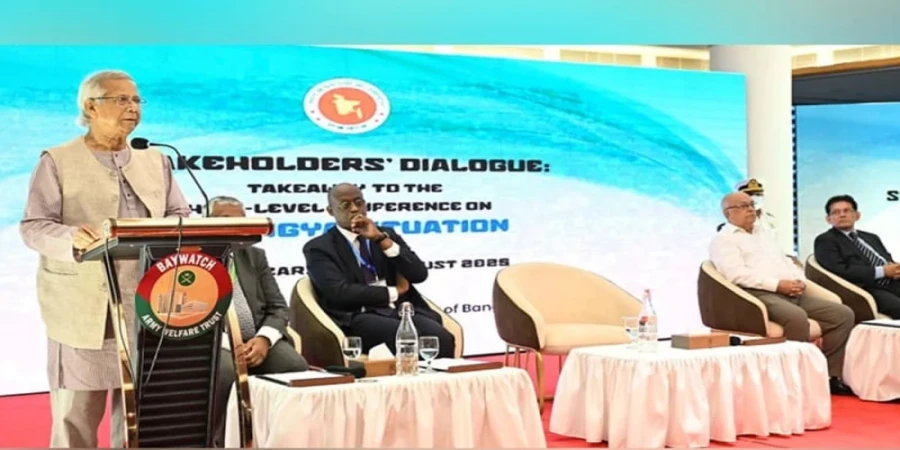
Speaking on Monday at the inauguration of the three-day international dialogue on the Rohingya issue, held at a hotel in Cox’s Bazar, Professor Yunus emphasized that the interim government is committed to handing over power to an elected authority after the polls, scheduled for the first half of February. He described the current period as a critical juncture in Bangladesh’s democratic journey.
“We are now at an important moment in our political history. Only a year ago we faced a terrible massacre. Through the student-led movement and the people’s uprising, we succeeded in freeing the country from authoritarian rule. Today, the situation has stabilized enough for us to proceed with elections,” he said in his address.
The Chief Advisor’s remarks come as Bangladesh prepares for the election that will mark the end of the caretaker administration. Political analysts view the February polls as a landmark event that could reshape the country’s governance structure and restore long-term stability following a turbulent political period.
The inauguration of the international dialogue, titled “Stakeholders’ Dialogue: Takeaway to the High-Level Conference on the Rohingya Situation”, also placed the global spotlight on the continuing plight of the Rohingya refugees. The three-day event has brought together representatives from international agencies, donor countries, and regional stakeholders to discuss pathways toward a sustainable solution to one of the most protracted refugee crises in the world.
In his keynote speech, Professor Yunus presented a seven-point proposal aimed at finding a durable solution to the Rohingya crisis. Stressing the urgency of immediate and coordinated international action, he called on the global community to do more to halt the persecution and displacement of the Rohingya population. He warned that prolonged inaction could deepen the humanitarian catastrophe and destabilize the region further.
Among his proposals were the formulation of a practical roadmap to ensure the rapid, safe, dignified, and sustainable repatriation of the Rohingya to their homeland; continued donor assistance to support the refugees and host communities; and a demand that Myanmar authorities, as well as the Arakan Army, guarantee security and livelihoods for the displaced population. He also urged constructive dialogue with the Rohingya people to restore their rights, active involvement of ASEAN and the wider international community, a stronger stance against genocide, and acceleration of accountability measures through international judicial mechanisms.
Professor Yunus underscored that without strong global commitment, the crisis would remain unresolved, leaving nearly a million Rohingya in Bangladesh trapped in uncertainty. “The world must act now. We cannot allow an entire people to live indefinitely without rights, security, or a future,” he said.
The dialogue in Cox’s Bazar is being closely watched by humanitarian organizations and international partners who see it as a key platform ahead of the forthcoming high-level conference on the Rohingya situation. Organizers expressed hope that the recommendations emerging from the event will feed directly into global decision-making processes and push forward efforts for a long-term settlement.
The Chief Advisor linked Bangladesh’s political transformation with its responsibility to uphold human rights and justice, suggesting that the country’s transition to elected governance should run parallel to stronger advocacy for the Rohingya cause. He noted that the people of Bangladesh, having endured violence and repression themselves, could empathize deeply with the plight of the refugees.
Observers at the event pointed out that while the February election is expected to usher in a new chapter in Bangladesh’s political trajectory, the Rohingya crisis will remain one of the most pressing foreign policy and humanitarian challenges for the incoming government. Analysts added that balancing domestic stability with international obligations will be a key test of leadership in the coming years.
The Cox’s Bazar dialogue has drawn participation from senior officials, diplomats, aid organizations, and civil society groups, all of whom are engaged in discussions about the next steps required to secure lasting peace and justice for the Rohingya. The event continues for three days, after which its outcomes will be presented at a global forum.
Professor Yunus concluded his address by reaffirming the interim government’s dual commitments: ensuring a smooth transition to elected leadership through the February elections, and keeping the Rohingya issue at the forefront of international attention until a sustainable solution is achieved.
reporter