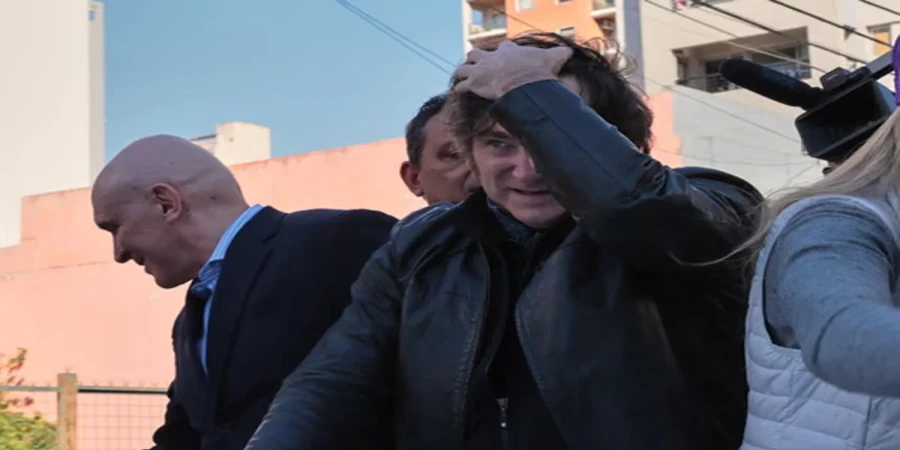
ছবি: -Collected Photo
Argentine President Javier Milei found himself at the center of a chaotic scene on Wednesday when an angry crowd hurled stones, bricks, and bottles at him during a campaign event in the capital, Buenos Aires. The incident has underscored rising public discontent in the country, where political tensions have been mounting in the run-up to key midterm and local elections.
Milei, accompanied by his sister Karina Milei—who also serves as a prominent figure in his administration—had joined party members at the rally, which was aimed at energizing supporters ahead of the polls. What began as a routine campaign stop quickly spiraled out of control when a section of the crowd turned hostile. Witnesses reported that several individuals started throwing bricks, stones, and other objects in the direction of the president and his entourage, forcing security forces to intervene. Amid the chaos, the president reportedly suffered injuries, though the extent has not yet been fully disclosed.
Security personnel acted swiftly to shield the president and his team, but the situation escalated so rapidly that Milei and his close aides were rushed into vehicles and escorted out of the area. The abrupt departure left behind a tense atmosphere, as clashes between the crowd and police continued even after the president’s exit. The incident has raised serious concerns about political stability, security arrangements, and the volatile mood of Argentine voters in the current climate.
Observers have linked the hostility directed at Milei to a series of controversies that have surrounded his administration in recent weeks. At the center of the unrest is a high-profile corruption scandal that has rocked the government. Allegations of bribery and financial misconduct have placed the administration under a harsh spotlight, with Milei’s sister, Karina, being directly implicated in the affair. Reports circulating in the media suggest that she played a role in questionable dealings that have further damaged the credibility of the government. The allegations have sparked anger among the public, fueling protests and intensifying scrutiny of the president’s leadership.
The timing of the scandal could not be more critical. With elections looming, Milei has been attempting to rally public support through his trademark fiery speeches and unconventional campaign style. Yet, instead of strengthening his political base, the corruption claims and the violent turn of events in Buenos Aires may weaken his standing. Political analysts have warned that the attack marks a significant shift in public sentiment, where frustration over economic hardship, governance challenges, and ethical questions about leadership are converging into visible acts of defiance.
Argentina, grappling with soaring inflation and persistent economic crises, has witnessed growing discontent in recent months. Milei, who rose to prominence with his anti-establishment rhetoric and promises of radical change, is now struggling to reconcile his populist image with the realities of governance. His administration’s handling of economic policy has drawn sharp criticism from opposition leaders and ordinary citizens alike, many of whom argue that little has improved under his leadership. The latest scandal has only intensified this dissatisfaction, painting a picture of a government caught between lofty promises and mounting public outrage.
The attack on the president has also triggered debate about political violence and democratic norms in Argentina. While protests and heated demonstrations are not uncommon in the country’s political landscape, direct assaults on sitting presidents remain rare. Commentators fear that such incidents could set a dangerous precedent, encouraging further hostility and eroding the space for peaceful political engagement. The government has condemned the violence, labeling it an attack not just on Milei but on Argentina’s democratic process. Authorities have vowed to investigate the incident thoroughly and bring those responsible to justice.
For Karina Milei, the president’s sister and a key figure in his inner circle, the fallout from the scandal and the attack could prove particularly damaging. Already under fire for her alleged role in the bribery case, her public appearance alongside the president at the rally became symbolic of the grievances fueling the crowd’s anger. Critics argue that her presence served as a flashpoint, further inflaming tensions among those who view the administration as compromised by corruption.
Despite the dramatic setback, Milei has signaled that he will not retreat from the campaign trail. In statements following the incident, his team emphasized his determination to continue engaging with citizens and promoting his vision for Argentina’s future. However, questions linger about how he will regain public trust in the face of both security threats and ongoing allegations of misconduct within his government.
The Buenos Aires attack has now become a focal point in the national conversation, drawing reactions from across the political spectrum. Opposition leaders condemned the violence but were quick to remind voters of the controversies surrounding Milei’s presidency. Civil society groups, meanwhile, have called for restraint, urging both politicians and citizens to channel their frustrations through democratic means rather than violence. International observers are also monitoring the developments closely, aware of Argentina’s pivotal role in regional politics and the potential implications of growing instability.
As the nation looks ahead to the upcoming elections, the incident serves as a stark reminder of the high stakes and deep divisions that characterize Argentina’s political landscape. President Javier Milei’s promise to overhaul the system and confront entrenched elites once earned him widespread support. Today, however, that promise is being tested not only by economic challenges and corruption scandals but also by the rising anger of a population increasingly willing to express its frustrations in volatile and unpredictable ways. Whether Milei can weather this storm and restore confidence in his leadership will likely define both his presidency and Argentina’s immediate political future.
reporter