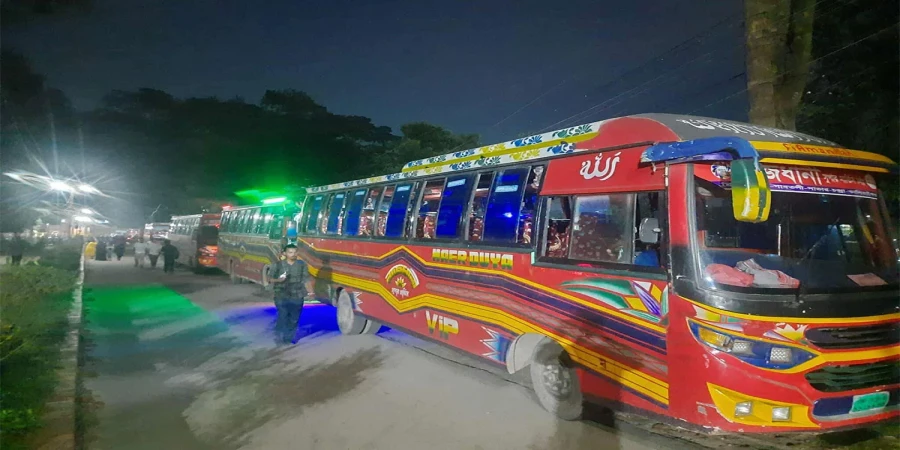
ছবি: -Collected Photo
Tensions ran high at Jahangirnagar University (JU) in Savar after a female student was allegedly pushed off a moving bus operated by Capital Transport, sparking a student protest that resulted in the detention of 28 buses for nearly 16 hours. The standoff was eventually resolved on Wednesday after the transport owners agreed to pay Tk 30,000 in compensation and issued a formal apology in the presence of university authorities.
The incident occurred on Tuesday evening when Halima Khatun, a student of the Department of Public Administration from the 2020–21 academic session, was returning from private tuition. As she attempted to board a bus of Capital Transport at the Savar Thana Stand along the Dhaka–Aricha highway, an altercation with the bus helper ensued. According to her account, the helper asked her destination. When she responded “Jahangirnagar,” he appeared to mishear it as “Jirani.” Upon repeating her answer, she alleged that the helper shoved her, causing her to fall from the bus just as the driver accelerated, leaving her injured on the road.
The victim later shared her ordeal on social media, posting on Facebook that she suffered pain in her leg as a result of the fall. In her post, she expressed frustration, claiming that this was not the first time she had been subjected to mistreatment on public buses. “I said Jahangirnagar, but he shoved me out just as the bus started moving. I fell and got injured. I have faced such behavior before too,” she wrote. The account quickly spread online and mobilized outrage among her peers.
In response, a group of JU students intercepted 28 buses belonging to Capital Transport plying the Dhaka–Aricha route and held them on campus premises. For hours, the protest disrupted traffic and paralyzed bus operations. Students demanded accountability from the transport company, financial compensation for the victim, and assurances that similar incidents would not occur in the future.
On Wednesday afternoon, negotiations took place between representatives of Capital Transport and the protesting students in the presence of the university’s proctorial team. JU Proctor Professor A.K.M. Rashidul Alam mediated the talks, where Halima’s classmates were also present. Following deliberations, the transport authorities admitted fault, issued a written undertaking (muchleka), and paid Tk 30,000 to the victim as compensation.
Professor Rashidul Alam later confirmed the outcome to reporters. “The owners admitted their mistake, apologized, and pledged in writing to behave respectfully with students in the future. They have also paid Tk 30,000 to the affected student as compensation,” he said. With this resolution, students released the buses after holding them for nearly 16 hours.
The incident reflects ongoing tensions between university students and public transport workers on routes surrounding Jahangirnagar University. Past grievances include reports of verbal harassment, physical intimidation, and reckless driving. Students have repeatedly voiced concerns about the lack of accountability within the transport sector, particularly toward women commuters. Tuesday’s altercation, however, escalated to one of the largest student actions against bus operators in recent years.
Witnesses at the scene recounted how the buses were brought inside the campus by angry students after Halima’s social media post circulated widely. Throughout the night and into Wednesday morning, large groups of students maintained the blockade, chanting slogans and demanding immediate redress. University security personnel remained on alert to prevent clashes.
During the negotiations, the transport company initially resisted paying compensation, citing the incident as a misunderstanding. However, the firm relented after students stood firm on their demands and the proctor’s office intervened. The signed undertaking, a formal declaration of accountability, was a key part of the settlement. It obligates the company to ensure respectful behavior by its staff and to prevent recurrence of such incidents.
For Halima, the resolution provided some relief but also highlighted a broader pattern of unsafe practices for students commuting on public transport. She told her classmates that she still felt shaken by the experience of being pushed from a moving bus. Her peers emphasized that beyond the monetary compensation, the written pledge from the company was critical in ensuring long-term behavioral change.
The wider student body at Jahangirnagar University has a history of mobilizing against perceived injustices, ranging from campus governance issues to local transport disputes. Observers noted that Tuesday’s protest bore similarities to earlier incidents where students enforced bus detentions following accidents or altercations. Such actions have become a powerful tool in pressing transport operators for accountability in the absence of stronger regulatory enforcement.
Traffic along the Dhaka–Aricha highway, a major artery connecting the capital with the country’s northwest, remained disrupted for several hours due to the standoff. Commuters faced delays, while drivers of other buses expressed frustration over being caught in a dispute between students and the company. Police personnel stationed nearby monitored the situation but refrained from direct intervention, allowing university authorities to manage the negotiations.
By Wednesday evening, as buses were finally released, normalcy began to return along the route. Capital Transport owners assured both the students and university officials that they would review their training and monitoring mechanisms for staff behavior. The company also committed to disciplining employees involved in the incident.
The case has reignited debate about public transport safety, particularly for women passengers in Bangladesh. Analysts argue that without stricter regulations and improved passenger protections, incidents like Halima’s are likely to recur. University students, by virtue of their collective voice, have managed to extract accountability in this instance, but ordinary commuters remain vulnerable to mistreatment.
As the matter subsided with buses resuming operations, questions lingered about whether the settlement would be enough to deter future abuses. For Jahangirnagar University students, the episode underscored the power of collective action, while for transport operators it served as a stark reminder of the costs of negligence in passenger safety.
reporter